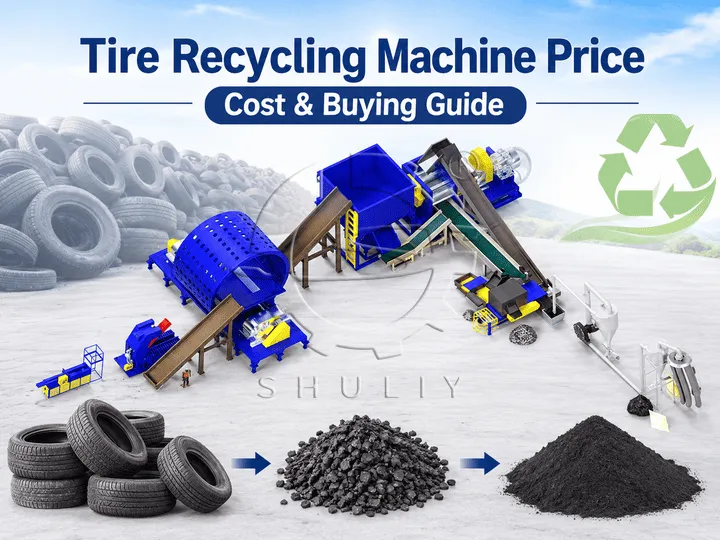
Tire recycling machine price is one of the first things investors consider when planning a waste tire recycling business. However, the total investment depends on more than the price of an individual machine. Tire size, processing capacity, final product requirements, automation level, and equipment configuration all influence the cost.
Some customers only need a tire shredder to process waste tires into rubber blocks, while others want a complete production plant that produces rubber granules or fine rubber powder. These two projects require very different equipment configurations.
In this guide, we explain the main factors affecting tire recycling equipment costs and how to choose a suitable solution for your business.
1. What Types of Tire Recycling Machines Can You Buy?
Before estimating your investment, it is important to understand the different types of tire recycling equipment available. The machines you need depend on how far you want to process your waste tires.
Individual Tire Recycling Machines
If you already have some processing equipment or only need to complete one production stage, purchasing individual machines may be a practical option.
Common equipment includes:
- Tire Debeader : Removes steel wire from the tire bead.
- Tire Cutter : Cuts whole tires into smaller sections for easier processing.
- Tire Shredder : Shreds tires into rubber blocks or chips.
- Rubber Crusher Mill : Grinds rubber materials into smaller granules or powder.
- Magnetic Separator: Removes steel wires and metal particles from rubber materials.
- Fiber Separator : Separates nylon fibers from rubber materials.
The investment depends on the machine model, processing capacity, and required output size.
Complete Tire Recycling Plant
For customers who want to process waste tires into finished rubber products, a complete tire recycling plant is a more comprehensive solution.
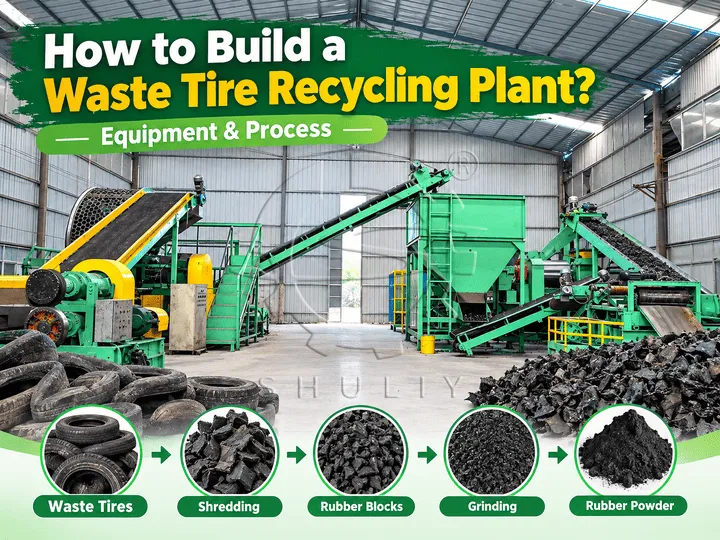
A typical production process includes:
- Removing steel wire from tire beads.
- Cutting tires into strips or blocks when necessary.
- Shredding tires into smaller rubber pieces.
- Grinding rubber into granules or powder.
- Separating steel wire and nylon fibers.
- Screening and collecting the finished rubber materials.
The final configuration can be adjusted according to the customer’s raw materials and production goals.
2. How Much Does a Complete Tire Recycling Plant Cost?
There is no single price for a complete tire recycling plant because different projects require different processing stages and equipment capacities.
For example, consider the following configurations:
| Project Type | Main Equipment | Final Product |
|---|---|---|
| Basic tire shredding | Debeader, tire shredder | Rubber blocks or chips |
| Rubber granule production | Pretreatment equipment, shredder, crusher, separator | 1–5 mm rubber granules |
| Rubber powder production | Complete crushing, grinding, screening and separation equipment | 10–40 mesh rubber powder |
| OTR tire recycling | Specialized wire drawing, cutting and shredding equipment | Rubbwe granules |
A basic shredding project requires fewer processing stages than a complete rubber powder production plant.
Likewise, a production line designed for large mining tires needs different equipment from one processing ordinary passenger car and truck tires.
Therefore, the most accurate way to determine the equipment investment is to configure the machinery according to your actual production requirements.
3. Six Factors That Affect Tire Recycling Machine Price
When comparing tire recycling machine quotations, it is important to understand what is included in each configuration.
Here are six major factors that influence the total investment.
1. Tire Size and Type
The size and structure of waste tires directly affect equipment selection.
For ordinary passenger car and truck tires with diameters up to 1200 mm, a conventional tire recycling system can handle the pretreatment, shredding, grinding, and separation processes.
However, large OTR (Off-the-Road) tires used in mining and heavy-duty industries require specialized equipment.
These tires can have diameters ranging from approximately 1800 mm to 4000 mm, including large R35–R63 mining tires.
Their thick rubber layers and heavy steel structures require stronger cutting and wire-removal equipment.
Consequently, an OTR tire recycling project generally requires a different investment plan from a standard waste tire recycling project.
2. Production Capacity
How many tons of waste tires do you want to process per hour?
Production capacity is one of the most important factors affecting the equipment configuration.
A small-scale project may only need a relatively simple processing system, while a high-capacity plant requires larger machines and more supporting equipment.
For example, increasing production capacity may involve:
- Larger or more powerful shredding equipment.
- Higher-capacity grinding systems.
- Additional screening and separation equipment.
- More efficient material conveying systems.
When requesting a quotation, it is better to specify your required hourly processing capacity rather than simply asking for a tire recycling machine price.
3. Final Rubber Particle Size
What products do you plan to sell after recycling?
Different finished products require different grinding and screening configurations.
Rubber Granules (1–5 mm)
Rubber granules are commonly used in:
- Rubber flooring and playground surfaces.
- Running tracks.
- Rubber mats.
- Other molded rubber products.
Rubber Powder (10–40 Mesh)
Finer rubber powder is used in:
- Rubber products manufacturing.
- Modified asphalt applications.
- Reclaimed rubber production.
- Other industrial applications.
The required particle size determines the grinding and screening equipment needed. Finer powder production may require additional grinding stages and more precise screening.
Therefore, the smaller the required particle size, the more carefully the grinding system needs to be configured.
4. Automation Level
Another important factor is how much of the production process you want to automate.
Semi-Automatic Tire Recycling Plant
A semi-automatic tire recycling plant configuration is suitable for customers who want to reduce their initial equipment investment and can arrange workers for certain manual operations.
Typical characteristics include:
- Manual feeding or material transfer in selected stages.
- Separate machines for different processing steps.
- Operators responsible for monitoring and coordinating production.
- Flexible equipment combinations.
Fully Automatic Tire Recycling Plant
A fully automatic system integrates more processing stages through conveyors, automatic feeding systems, and centralized control.
Its main advantages include:
- Reduced manual material handling.
- More continuous production.
- Better coordination between processing stages.
- More convenient operation and production management.
The actual automation level depends on the selected equipment and project requirements.
5. Equipment Configuration
Not every customer needs to purchase every machine in a complete production line.
For example, some customers already have tire cutting equipment and only need shredding and grinding machinery.
Others have pre-treated rubber blocks and want to process them directly into rubber granules or powder.
The equipment configuration can be adjusted according to the existing machinery and processing requirements.
A customized solution helps avoid unnecessary equipment purchases and makes better use of the available investment budget.
6. Installation, Shipping and Supporting Equipment
The total project budget should also account for supporting expenses beyond the main machines.
These may include:
- Material conveyors and feeding systems.
- Electrical control cabinets and cables.
- Spare parts and consumables.
- Equipment installation and commissioning.
- International transportation.
- Factory layout and installation requirements.
When comparing quotations from different suppliers, make sure you understand which items are included and which are optional.
4. Semi-Automatic vs. Fully Automatic Tire Recycling Plant: Which Is More Economical?
Both systems can process waste tires into valuable rubber materials, but they are designed for different production requirements.
| Comparison | Semi-Automatic | Fully Automatic |
|---|---|---|
| Initial investment | Generally lower | Generally higher |
| Labor requirements | More manual operations | Less manual handling |
| Material transfer | Some manual handling | More conveyor-based |
| Production management | Operator coordination | Centralized control |
| Suitable projects | Small and medium-scale projects | Larger or continuous production projects |
A semi-automatic system may be a good choice if your budget is limited and you have enough workers to handle manual operations.
A fully automatic tire recycling line is worth considering if you want to reduce manual handling and operate a more integrated production process.
However, automation should not be the only factor in your decision. Your expected output, working hours, labor costs, and local operating conditions should also be considered.
5. How to Choose the Right Tire Recycling Equipment for Your Budget
Choosing the cheapest machine does not always mean making the best investment. The equipment must match your raw materials and the products you intend to manufacture.
Before purchasing a tire recycling machine, consider the following questions:
What types of tires will you process?
Are they passenger car tires, truck tires, or large OTR mining tires? Different tire structures require different pretreatment equipment.
What is your expected production capacity?
Determine how many tons of waste tires you want to process per hour or per day.
What finished products do you need?
Do you want rubber chips, 1–5 mm rubber granules, or 10–40 mesh rubber powder?
Do you already have any processing equipment?
If you already own a shredder or cutting machine, we can consider incorporating it into the new production system where technically suitable.
How automated should the production process be?
Decide whether you prefer manual feeding and separate processing stages or a more integrated automatic system.
By answering these questions, you can narrow down the equipment configuration and avoid spending money on unnecessary machinery.
6. Get a Customized Tire Recycling Machine Quotation from Shuliy
At Shuliy, we provide waste tire recycling equipment for different processing requirements, from individual machines to complete rubber granule and powder production plants.
Our solutions cover ordinary waste tires with diameters up to 1200 mm as well as large OTR tires used in mining and heavy-duty industries.
Depending on your project, we can help configure:
- Tire wire drawing and cutting machines.
- Tire shredders.
- Rubber crusher and grinding machines.
- Magnetic separation systems.
- Nylon fiber separators.
- Complete rubber granule and powder production plants.
We can also adjust the grinding and screening configuration according to your required rubber particle size.
To receive an accurate tire recycling machine quotation, please share the following information with us:
- Your country and the type of waste tires you want to process.
- Tire diameter or tire specifications.
- Required processing capacity (tons per hour).
- Desired final product and particle size.
- Whether you need a semi-automatic or fully automatic system.
Our team will evaluate your requirements and recommend a suitable equipment configuration.
Contact Shuliy today to discuss your waste tire recycling project and get a customized solution.
WhatsApp: +86 173 0382 1432